

The Hidden Wealth Cost of Unpaid Care Work
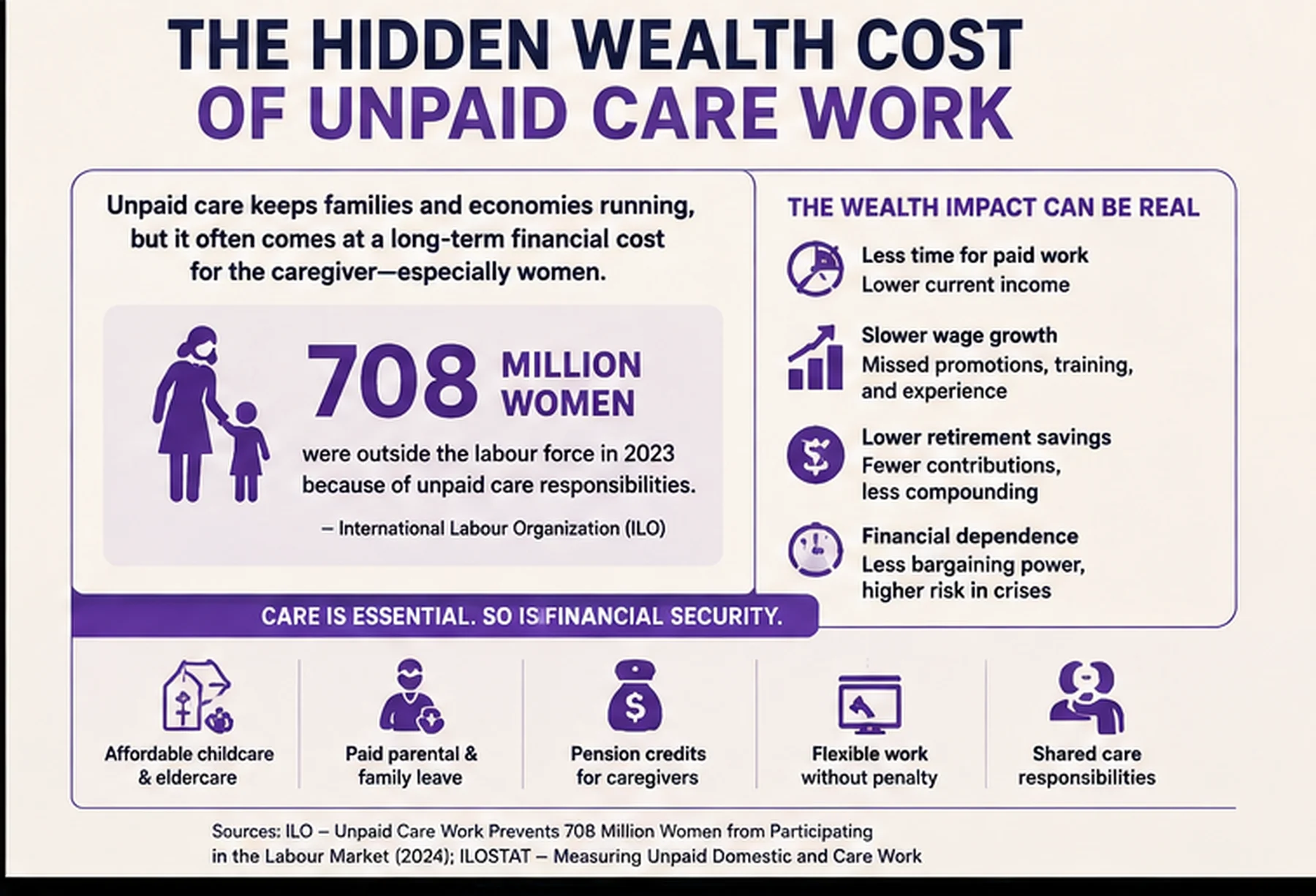
Caring for children, older relatives, people with disabilities, and household members is essential work. Economies could not function without it, yet much of this labour is unpaid and excluded from ordinary measures of employment and income. The financial cost does not end when the care task is completed. Time spent outside paid employment can reduce wages, promotion opportunities, pension contributions, savings, and lifetime wealth. The International Labour Organization estimated that 708 million women worldwide were outside the labour force in 2023 because of unpaid care responsibilities. This does not mean that men perform no unpaid care or that every woman experiences the same burden. It shows that care responsibilities are distributed unequally and can become a major barrier to paid work. The first financial effect is a reduction in working time. A caregiver may leave a job, move to part-time employment, reject a promotion requiring longer hours, or choose work close to home rather than a better-paid position farther away. These decisions may be necessary for the household, but they reduce current income. The second effect is slower wage growth. Pay often increases through experience, job changes, training, and promotion. A career interruption can mean missing several rounds of progression. When the caregiver returns, employers may treat the absence as lost experience even when the person developed organizational, communication, and crisis-management skills through care. The wage gap can therefore continue long after the period of full-time care ends. The third effect is reduced retirement wealth. Pension systems commonly depend on earnings, contributions, or years in paid employment. A person who works fewer hours or leaves the labour force may contribute less to public, occupational, and private pensions. In a defined-contribution system, lower contributions also have less time to earn investment returns. A short interruption early in a career can therefore have a larger effect than the same interruption near retirement because decades of potential compounding are lost. Care responsibilities also affect household bargaining power. A person without independent income or savings may become financially dependent on a partner or relative. This can make it harder to leave an abusive or unstable relationship. In the event of divorce, separation, or the death of the main earner, the caregiver may have fewer assets and weaker recent work experience. The household may have benefited from the unpaid labour, but the financial cost is often concentrated on the individual who provided it. The distribution of care also affects employers and the wider economy. When skilled workers leave employment because childcare or eldercare is unavailable, organizations lose experience and face recruitment costs. Labour shortages can exist at the same time that qualified people are unable to work. The economy records the paid replacement of care as economic activity but may record unpaid family care as nothing, even when the same task is being performed. This makes unpaid care less visible in conventional statistics and policy debates. Public childcare and eldercare can change these outcomes. Reliable services allow caregivers to enter employment, increase hours, attend training, and accept jobs with less predictable schedules. Paid parental and family leave can protect employment during temporary care periods. However, leave policies can reinforce inequality when they are available only to formal workers, paid at very low rates, or used almost entirely by women. Encouraging and enabling fathers and partners to use leave can distribute career costs more evenly. Flexible work can help, but flexibility should not mean permanently lower pay, reduced promotion, or an expectation that the employee is available for both work and care simultaneously. Remote work does not replace childcare for young children or intensive care for a dependent adult. Pension credits for caregiving periods can reduce retirement penalties, while direct cash benefits can recognize immediate household needs. These policies involve public costs, but unpaid care already has costs. The question is whether those costs are hidden and concentrated on individual families or shared through public systems and employment protections. Cultural expectations also matter. Women are often assumed to be the default caregivers, while men may face workplace pressure not to take parental or family leave. Changing formal policy without changing workplace practice may have limited effect. Managers must evaluate performance based on results rather than constant physical availability, and caregiving should not be treated as evidence that a worker lacks commitment. Care policy should also avoid presenting paid caregivers and family caregivers as opponents. Professional care workers provide necessary skilled services and should receive fair pay and protection. Family members may still want or need to provide part of the care. A strong system gives households real choices instead of forcing unpaid care because no affordable alternative exists. The wealth gap created by care is not simply a matter of individual budgeting. It is produced through lost income, interrupted careers, reduced retirement contributions, and limited access to assets. Measuring this effect makes visible the economic value of work that society depends on but often refuses to count. The objective is not to eliminate family care. It is to ensure that providing necessary care does not automatically create long-term poverty or financial dependence for the person who performs it.
Sources: International Labour Organization, “Unpaid Care Work Prevents 708 Million Women from Participating in the Labour Market”; ILOSTAT, “Measuring Unpaid Domestic and Care Work”; ILO research on care work and labour-force participation.
Image caption: A simplified pathway showing how unpaid care responsibilities can lead to reduced paid work, lower lifetime earnings, and lower retirement wealth.
Image alt text: Infographic showing 708 million women outside the labour force because of unpaid care responsibilities and the connection between care, employment, earnings, and retirement assets.