

Why a Rising Wage Bill Can Make a Football Club Fragile
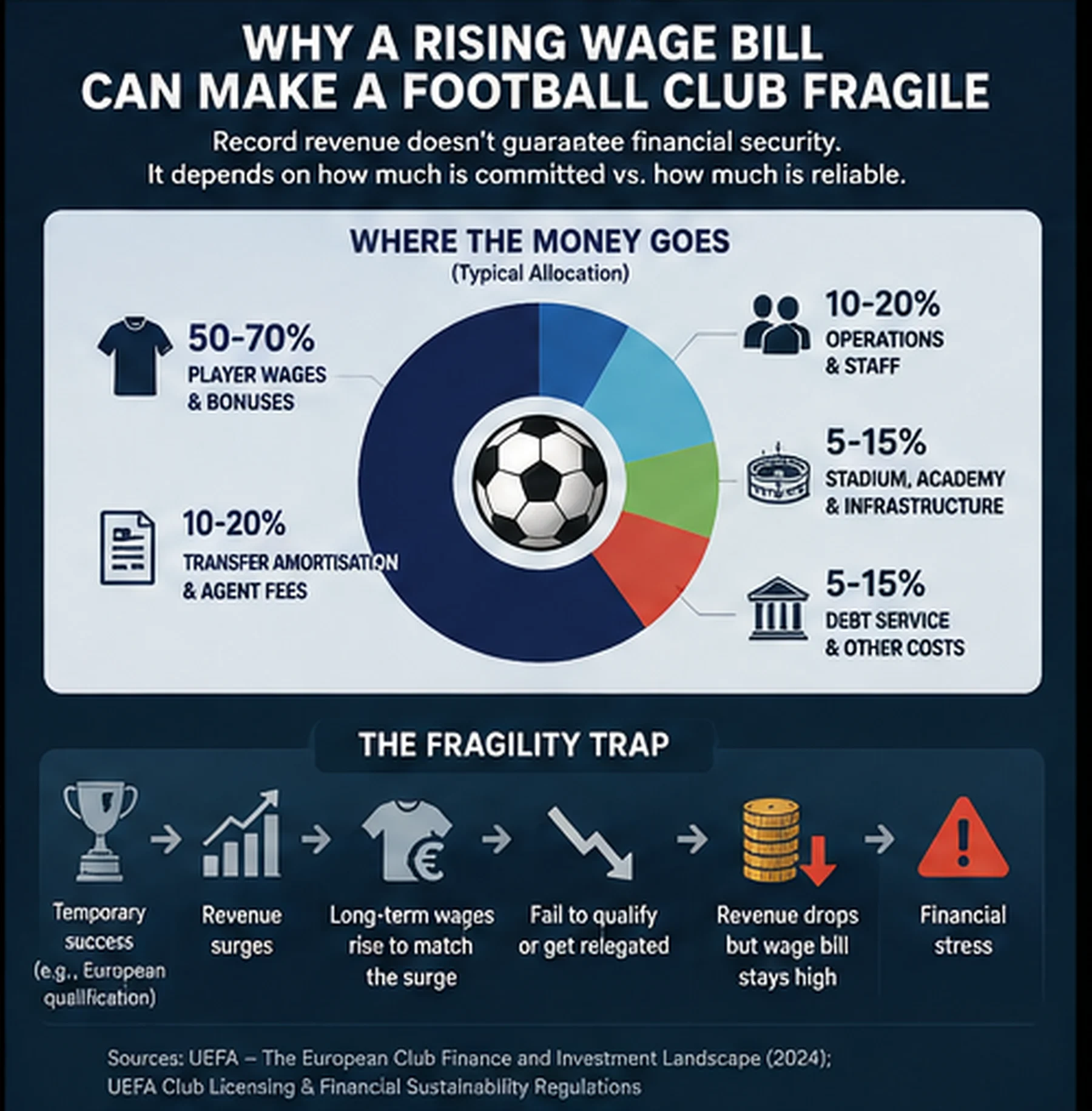
Football clubs frequently announce record revenue while supporters assume that the club can therefore afford any transfer or salary. Revenue is important, but it is not the same as available cash or financial security. A large share may already be committed to player wages, coaching staff, transfer payments, debt, stadium operations, academies, and administrative costs. A club can grow commercially and still become more fragile when permanent expenses rise faster than dependable income. Wages are usually among the largest recurring costs. A transfer fee may be negotiated once, but a player contract creates regular salary obligations for several years. Bonuses, image rights, agent fees, signing payments, employer taxes, and contract extensions can add further costs. Coaching and technical staff also contribute to the total wage bill. When several expensive contracts overlap, management loses flexibility because wages continue even when players are injured, out of form, or no longer central to the team. The danger is greatest when clubs treat temporary income as permanent. Qualification for the Champions League or another international competition can produce substantial broadcasting, prize, ticket, and commercial revenue. Promotion to a richer league can have a similar effect. A club may respond by signing players on contracts that assume the new level of income will continue. If the club fails to qualify the following season or is relegated, revenue can decline quickly while the contracts remain. Relegation clauses and performance-based wages can reduce this risk, but they may make recruitment more difficult because players prefer guaranteed compensation. Transfer accounting can hide the pressure. When a club buys a player, the transfer cost is often recorded as an asset and charged as amortisation over the contract term rather than treated as one immediate expense in the profit-and-loss account. A €50 million player signed for five years may therefore create approximately €10 million in annual amortisation before wages and other fees. Several signings can build a large annual cost even when the original transfer payments are scheduled in instalments. Extending a contract can reduce annual amortisation by spreading the remaining book value over additional years, but it may also create a longer salary commitment. Selling a player can produce an accounting profit when the sale price exceeds the remaining book value. Academy players can generate particularly large accounting profits because they may have little recorded acquisition cost. This can encourage clubs to sell home-grown players in order to improve financial results. Such sales may be rational, but relying on them every year creates uncertainty. The market may weaken, a player may lose value, or supporters may oppose repeated sales of popular academy talent. Cash flow and accounting profit must therefore be examined separately. A club may report a profit while still waiting for transfer instalments, or it may have cash available after receiving a large payment while recording the related profit differently across reporting periods. Revenue sources also carry different levels of stability. Domestic broadcasting income may be relatively predictable while the club remains in the league. Commercial agreements can be multi-year but may depend on sporting visibility or relationships with the owner. Matchday income depends on attendance, pricing, stadium capacity, and hospitality demand. Competition income can change dramatically from one season to the next. Player sales are generally less reliable than recurring broadcasting and sponsorship contracts. Financial planning should distinguish between revenue that is likely to return and revenue that depends on exceptional sporting performance. UEFA reported that European top-division club revenue reached €26.8 billion in the 2023 financial year. Wages rose by 6.8 percent during that year, although revenue grew faster and the overall wage-to-revenue ratio fell. The aggregate picture does not mean every club became safer. Revenue remains highly unequal across leagues and clubs, and an individual club can have an unsustainable wage structure even while industry revenue reaches a record. Wage ratios are useful but incomplete. A club spending 60 percent of revenue on wages may still be financially weak if it has high transfer amortisation and debt. Another club with a higher ratio may own its stadium, carry little debt, and have stable sponsorship income. Analysts should examine total squad cost, recurring revenue, operating cash flow, debt terms, related-party sponsorships, and commitments due in future years. Sporting pressure makes cost control difficult. Owners and executives are judged by results, and a few league positions can determine millions in income. Spending more can increase the probability of success, but every club cannot outperform at the same time. When several teams borrow or commit future income to chase the same qualification places, some will inevitably miss their target. Financial stability requires preparing for that failure before it happens. A resilient club asks whether its ordinary revenue can support its ordinary wage bill without a major player sale, owner rescue, promotion, or European qualification every season. Performance bonuses can align costs with success. A balanced squad can prevent unused players from occupying large portions of the payroll. Academies and recruitment systems can produce value at lower cost, although they require patience and investment. Contracts should reflect realistic resale value and injury risk rather than assuming every signing will improve. Supporters may view financial restraint as a lack of ambition, particularly when rivals spend aggressively. However, ambition financed by obligations the club cannot sustain can result in points deductions, forced player sales, unpaid creditors, ownership crises, or long-term decline. The goal is not to minimize wages. Players are the central talent in the sport and should receive a fair share of the value they create. The goal is to keep wage commitments proportional to reliable income and to preserve enough capacity for the stadium, academy, staff, debt, and future squad development. Record revenue can make a club stronger, but only when management resists turning every temporary gain into a permanent cost.
Sources: UEFA, “The European Club Finance and Investment Landscape”; UEFA Club Licensing and Financial Sustainability Regulations; published football-club financial statements.
Image caption: Football revenue flows into wages, transfer amortisation, operations, infrastructure, and debt. Financial fragility increases when long-term wage commitments depend on uncertain competition or transfer income.
Image alt text: Infographic showing football-club revenue, committed wage and transfer costs, and the remaining financial capacity for debt, stadiums, academies, and future transfers.