

Income and Wealth Are Not the Same Thing
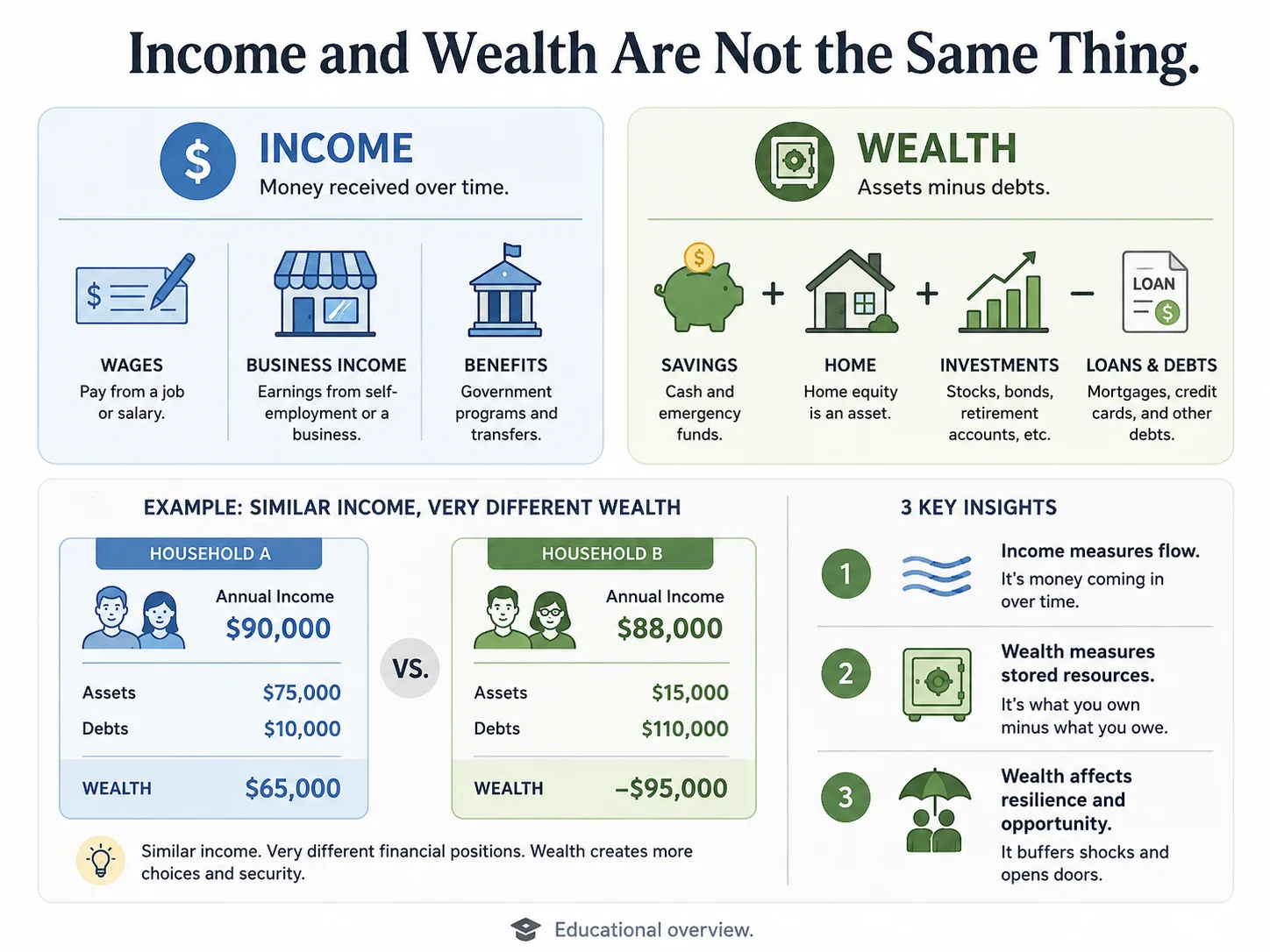
Income and wealth are often discussed as though they measure the same form of economic success, but they describe different realities. Income is a flow of money received over a period of time through wages, business profits, pensions, benefits, rent, interest, or other sources. Wealth is a stock of resources accumulated at a particular moment: property, savings, investments, business ownership, and other assets minus debts. A household can have a high income and little or negative wealth. Another household can report a modest income while owning a valuable home and financial assets accumulated over decades. This distinction helps explain why people with similar salaries can experience completely different levels of security. Consider two hypothetical households earning roughly the same annual income. The first owns its home with a small mortgage, holds emergency savings, and has retirement investments. The second rents, carries student and consumer debt, and has almost no savings. A temporary job loss creates inconvenience for the first household but may produce immediate crisis for the second. Income determines how much money is arriving now. Wealth determines how long a household can continue when income stops and which opportunities it can finance. Wealth can generate additional income through interest, dividends, rent, or business profits. It can also reduce expenses. A homeowner who has paid off a mortgage may face lower housing costs than a renter, even if the renter earns more. Families with savings can pay an unexpected bill without expensive borrowing. They can move for a better job, study without working full time, start a business, or help a child with education and housing. These options make wealth a form of resilience and opportunity, not merely a measure of luxury. Debt complicates the picture. Borrowing can build wealth when it finances an education, productive business, or reasonably priced home, but debt can also prevent accumulation when interest costs consume income. Two households may own similar assets while having very different net wealth because one financed them with much more debt. Measuring assets without liabilities therefore exaggerates financial security. Timing matters as well. People who bought homes or financial assets before major price increases may gain wealth without a comparable rise in wages. Those who enter later must save larger deposits and borrow more. This creates differences between age groups, but age alone does not explain everything. Inheritance, location, race, family structure, disability, employment stability, and access to credit influence whether income can be converted into wealth. A young professional with family assistance may accumulate assets faster than an older worker supporting relatives despite earning the same salary. Wealth is also distributed more unevenly than income. OECD data show that the top portion of the wealth distribution owns a much larger share of total wealth than the top portion of the income distribution receives of total income. This happens partly because assets can appreciate and generate returns, allowing existing wealth to compound. High-income households also have more money left to save after essential expenses. Lower-income households may spend nearly all income on housing, food, transportation, healthcare, and childcare, leaving little capacity to purchase appreciating assets. Public policy often focuses on annual income because it is easier to measure and tax. Income-based support can miss households that temporarily report low earnings while holding substantial assets. Strict asset tests, however, can punish modest saving and exclude people whose wealth is tied up in a home or retirement account. Effective policy must decide what problem it is trying to solve: insufficient current income, inability to survive emergencies, lack of access to assets, or extreme concentration of ownership. Each requires a different response. Raising wages and employment can reduce income inequality, but it may not quickly close wealth gaps created over generations. Broader access to stable housing, affordable education, retirement saving, consumer protection, and reasonably priced credit can affect asset accumulation. Estate and property taxation, capital-income rules, and public investment influence how advantages are transferred and compounded. No single measure captures economic well-being perfectly. Income indicates present purchasing power. Wealth indicates stored resources and protection against future shocks. Consumption shows actual living standards. Debt service shows financial pressure. A serious discussion of inequality should use all of them rather than assuming a paycheck tells the entire story. The most important question is not only how much a household earns this year, but what it owns, what it owes, what risks it can survive, and what opportunities it can realistically pursue.
Sources: OECD, “Society at a Glance 2024: Income and Wealth Inequalities”; OECD Income and Wealth Distribution Databases; OECD research on household wealth inequality.
Image caption: Income is money received over time, while net wealth is the value of assets minus debts. The household figures shown are hypothetical examples.
Image alt text: Infographic comparing income from wages, business, and benefits with wealth from savings, housing, and investments after subtracting loans and other debts.