

Where Football Club Revenue Comes From
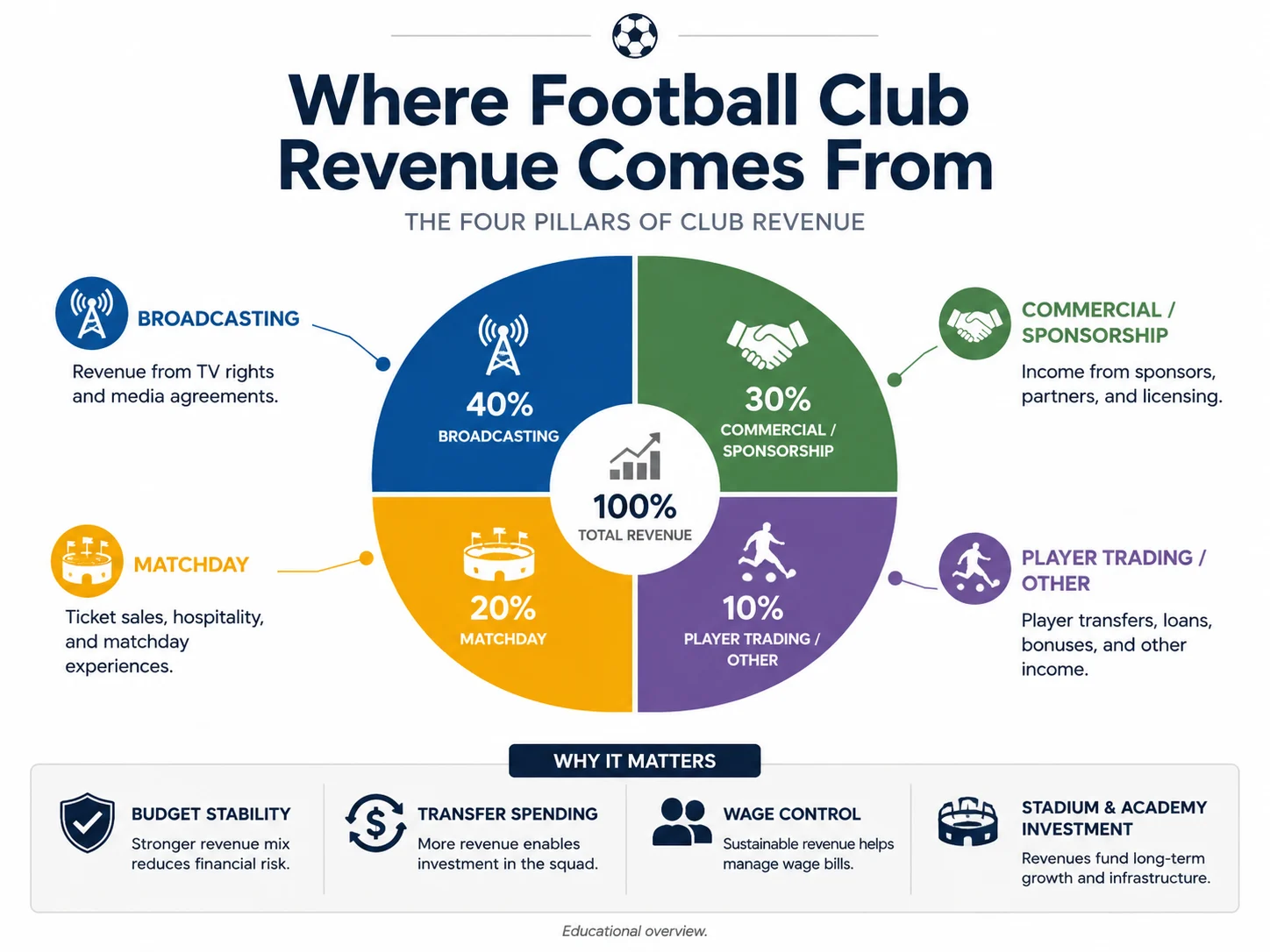
A football club can win matches and still experience financial difficulty. Sporting success influences revenue, but the financial health of a club depends on how reliably it turns attention, competition participation, facilities, and commercial rights into income. The main revenue categories are broadcasting, commercial activity, matchday operations, competition distributions, and player trading, although accounting labels differ across clubs and leagues. Broadcasting revenue comes from domestic leagues, cups, international competitions, and media agreements. In some leagues, television distributions form the largest source of income. The value depends on the size of the rights contract and the method used to divide it. Some systems distribute money relatively evenly, while others reward league position, television appearances, or audience size. Qualification for an international competition can dramatically increase revenue, but it also creates risk when a club builds permanent costs around income that is not guaranteed every season. Commercial revenue includes sponsorships, shirt and stadium partnerships, merchandise, licensing, tours, digital content, and corporate agreements. Large global clubs often earn substantial commercial income because they can offer sponsors an international audience. Smaller clubs may depend more heavily on local partners and community relationships. Commercial success is not simply a result of follower numbers. Sponsors consider brand reputation, market access, broadcasting exposure, player popularity, and the reliability of the competition. Matchday revenue includes tickets, premium seating, hospitality, food and beverage sales, stadium tours, and events. Stadium size matters, but capacity alone does not determine income. Attendance, ticket pricing, local wages, hospitality demand, and whether the club controls the stadium all influence the result. A modern stadium may generate revenue throughout the week through conferences, concerts, museums, restaurants, and retail. However, stadium construction also creates debt and operating costs. A new venue is not automatically a financial solution if demand or financing assumptions are unrealistic. Player trading is more complicated than an ordinary sale. Transfer fees may be recognized over different periods depending on accounting treatment, and the purchase cost of a player is often spread across the length of the contract. A club can report a transfer profit when it sells an academy player because the player may carry little recorded acquisition cost. This can make academy development financially valuable, but depending on regular player sales can weaken the team and produce unstable income. Transfer revenue should therefore be separated from recurring operating revenue when evaluating sustainability. Costs matter as much as revenue. Player wages, transfer amortisation, agent fees, coaching staff, stadium operations, travel, academies, and administration can rise quickly when clubs compete for promotion or qualification. A club whose revenue grows by 10 percent but whose wage bill grows by 20 percent may become less secure. Owners sometimes cover losses, but support can change, and football regulations may limit how much spending can be financed by persistent deficits. A strong revenue mix reduces dependence on one uncertain source. A club that relies mainly on broadcasting may be vulnerable to relegation or a weaker media contract. A club dependent on one sponsor may face difficulty when the agreement ends. A club dependent on selling players may struggle when the transfer market slows. Diversification can mean combining stable league distributions, realistic matchday income, multiple commercial partners, academy development, and disciplined transfer spending. Supporters are not merely customers in this model. Ticket pricing, kickoff scheduling, stadium relocation, sponsorship choices, and ownership decisions affect the relationship between the club and its community. Maximizing short-term income can damage long-term loyalty. The strongest clubs treat supporter trust as an asset that cannot be rebuilt instantly. When reading a club’s accounts, useful questions include: How much revenue is recurring? How dependent is the club on international qualification or promotion? What percentage of income is consumed by wages? Are transfer profits covering ordinary operating losses? Who owns the stadium? Is debt fixed or affected by interest rates? Are sponsorships connected to the owner and valued fairly? Football finance is not only about which club earns the most. It is about whether income is durable enough to support wages, infrastructure, youth development, and sporting ambition without requiring a perfect season every year.
Sources: UEFA, “The European Club Finance and Investment Landscape”; UEFA club licensing and financial sustainability reports; published club financial statements.
Image caption: Football clubs commonly earn money from broadcasting, commercial partnerships, matchday activity, competition payments, and player trading. The displayed percentages are illustrative and are not an industry average.
Image alt text: Infographic dividing an illustrative football club’s revenue among broadcasting, sponsorship, matchday operations, and player trading.