

Why Countries Need Migrants but Still Restrict Immigration
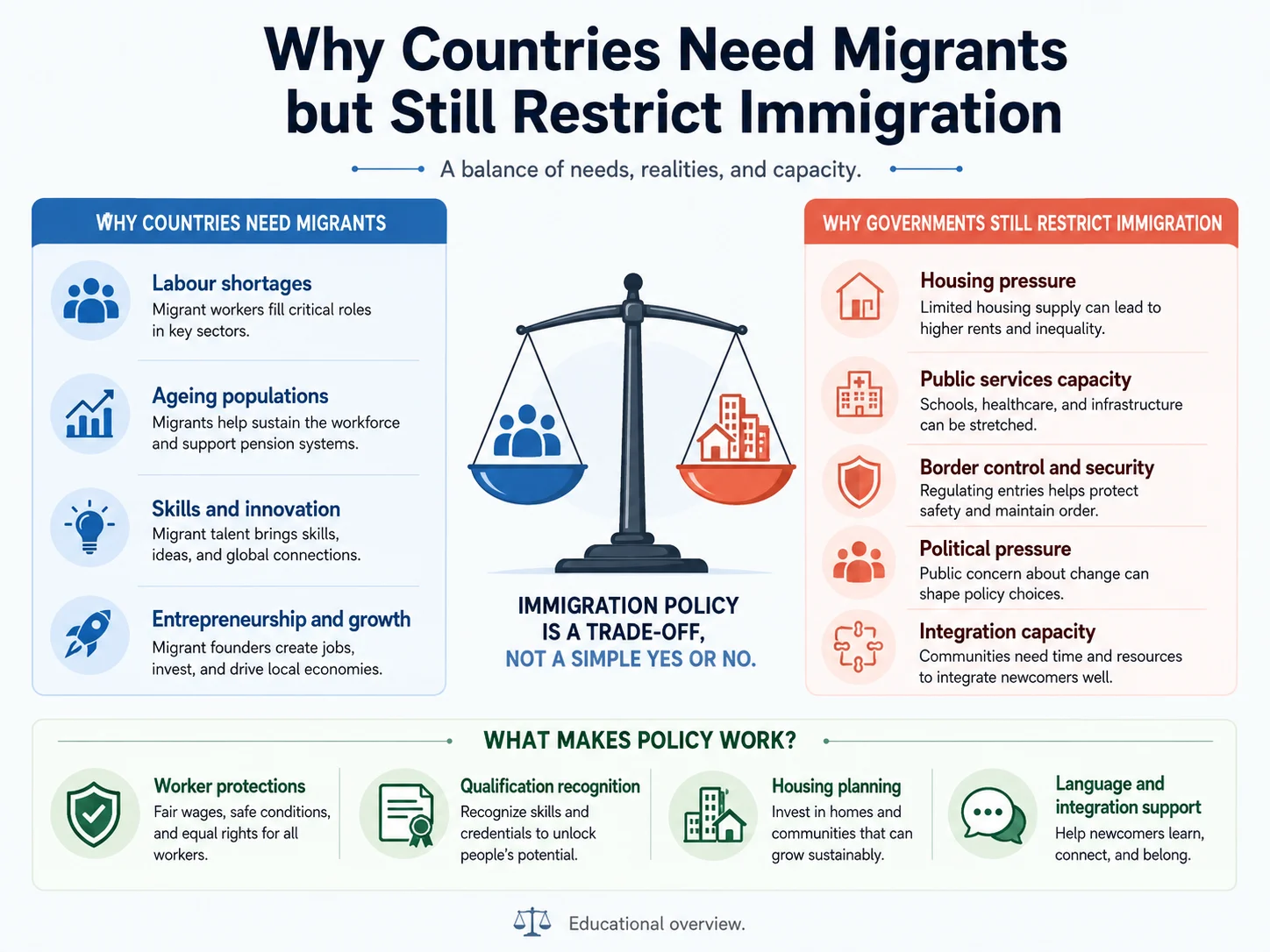
Immigration policy often seems contradictory. Governments recruit foreign nurses, engineers, farm workers, construction workers, and technology specialists while also promising stricter borders and lower migration. The contradiction becomes easier to understand when immigration is viewed as a trade-off between labour demand, public capacity, legal obligations, and political trust. Many countries need migrants because their populations are ageing and employers cannot recruit enough workers for particular occupations or regions. Labour shortages may exist even when unemployment has not disappeared. Available workers may lack the required licence, live far from the vacancy, need childcare, or reject wages and conditions offered by the employer. Migration can fill urgent gaps more quickly than training a new workforce, especially in healthcare and skilled occupations where education takes years. Migrants also start businesses, pay taxes, consume goods and services, and connect economies through international knowledge and trade. These benefits do not mean that every migration programme is well designed. Employers may use migrant recruitment instead of improving wages, safety, scheduling, technology, or domestic training. Workers whose legal status depends heavily on one employer may be reluctant to report exploitation. A credible labour-migration system should therefore test whether shortages are genuine, enforce minimum employment standards, allow workers to report abuse safely, and require employers to participate in training the local workforce. Immigration also affects places unevenly. National tax revenue and economic output may increase while particular cities experience greater demand for housing, schools, transportation, healthcare, and language services. These pressures are not proof that migrants caused years of underinvestment, but they are real capacity questions. When governments set migration targets without expanding homes and services, residents may experience higher rents, crowded infrastructure, or long waiting times. Public confidence declines when officials discuss only national benefits and dismiss local costs. Housing and infrastructure planning must therefore be connected to migration policy rather than treated as unrelated issues. Different legal categories should also be separated. Labour migrants are admitted mainly because of employment demand. International students enter for education, although some later work. Family migrants join relatives. Refugees and asylum seekers involve humanitarian protection and legal obligations. Temporary workers may be expected to leave, while permanent migrants are encouraged to settle and integrate. Combining every category into one emotional number prevents serious discussion. Each route has different objectives, rights, costs, and long-term consequences. Integration determines whether migration’s potential benefits are realized. Language education, qualification recognition, access to lawful work, school support, anti-discrimination measures, and clear pathways to permanent status can improve participation. Excluding migrants from stable employment may reduce short-term spending but create long-term poverty and social separation. At the same time, integration requires responsibilities from newcomers, employers, institutions, and the wider community. A policy that provides no language support and then blames migrants for limited language ability is poorly designed. A policy that offers support but never communicates expectations can also lose public confidence. Border control is another necessary part of the system. Governments are expected to know who enters, apply rules consistently, process claims within a reasonable period, and remove people who have no legal right to remain after fair procedures. Weak or extremely slow administration harms both sides: applicants remain uncertain for years, while the public concludes that the rules are not meaningful. Enforcement should be lawful and proportionate, but a migration system without credible administration becomes politically unstable. Origin countries face trade-offs as well. Remittances can support families and communities, but aggressive recruitment of doctors, nurses, and other scarce professionals may worsen shortages in poorer countries that financed their training. Ethical recruitment, training partnerships, and temporary or circular programmes can reduce this damage. Immigration is therefore neither a complete solution to ageing nor a single cause of economic pressure. Migration can reduce particular labour shortages, but it cannot replace productivity growth, childcare, vocational education, housing construction, or pension reform. Restriction alone cannot remove the demand that attracts workers, and unlimited admission cannot create the infrastructure required for successful settlement. A practical policy should answer five questions clearly: Which workers are needed and why? What rights and wages will they receive? How will housing and services expand? How will integration be supported and measured? How will the rules be enforced fairly? Countries often need migrants and restrict immigration because they are attempting to balance these questions. The quality of that balance matters more than whether policy is described simply as open or closed.
Sources: OECD, “International Migration Outlook 2025”; OECD, “Recent Developments in Migration Policy”; OECD, “Immigrant Integration: The Role of Firms.”
Image caption: Immigration policy balances labour and demographic needs against housing, service capacity, border administration, integration, and public trust.
Image alt text: Infographic showing reasons countries recruit migrants, reasons governments restrict immigration, and policies that can improve the balance.