

Why Housing Costs Create Tension Between Generations
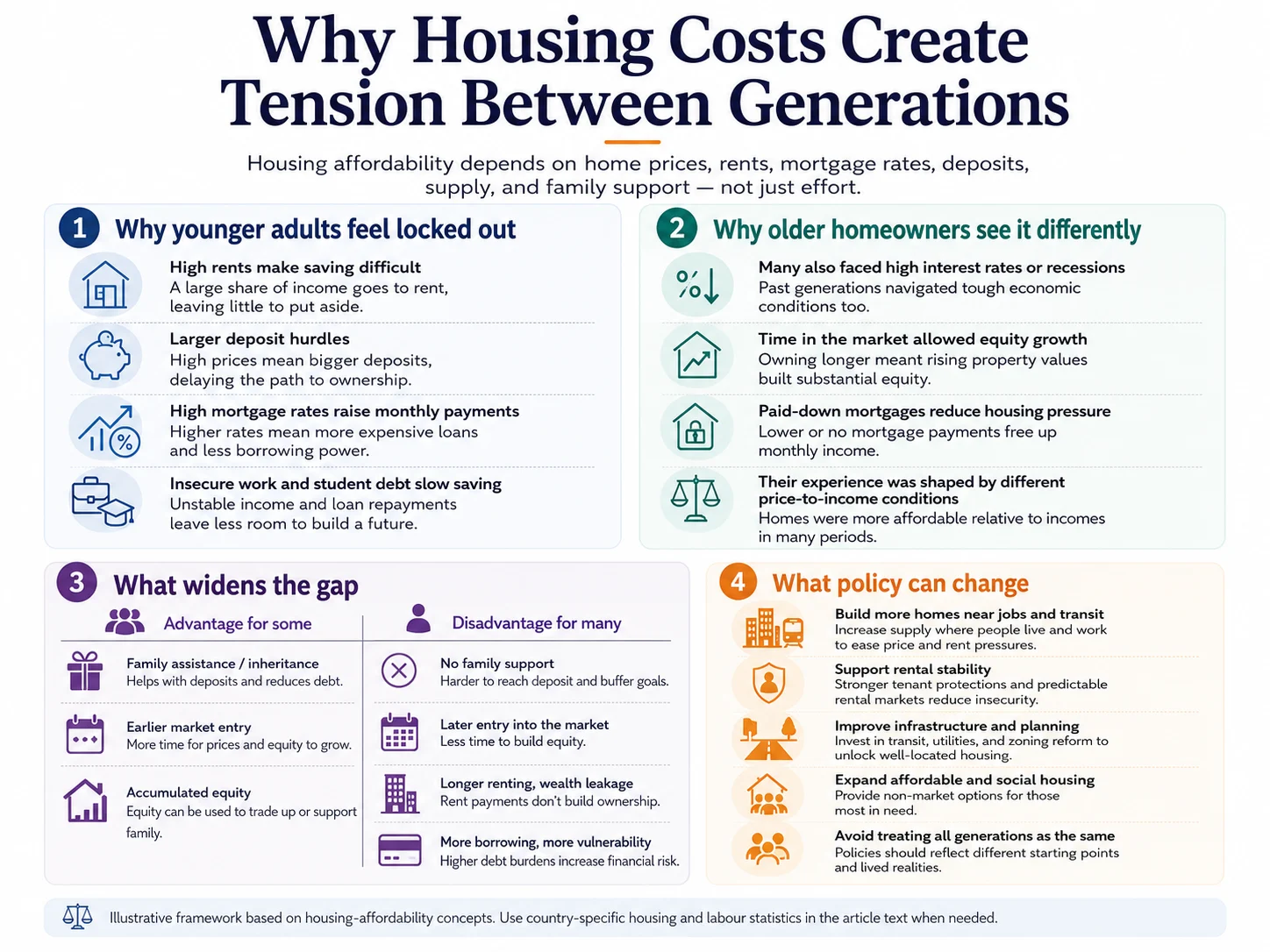
Housing debates often turn into arguments between generations. Younger adults say that homeownership has moved beyond reach, while older homeowners reply that they also saved, borrowed, and made sacrifices. Both statements can contain truth, but they describe experiences formed under different prices, interest rates, wages, housing supply, and family circumstances. The conflict becomes misleading when structural conditions are treated as differences in character. The price of a home matters only in relation to income, borrowing costs, required deposits, and other living expenses. A lower interest rate can make a large mortgage easier to service, while a higher rate can sharply raise monthly payments even if the purchase price is unchanged. High rents can make it harder to save for a deposit, creating a cycle in which people pay substantial housing costs without building ownership equity. Student debt, insecure employment, childcare costs, and delayed partnership or marriage can also change the path into homeownership. Older owners often benefited from time in the market. This does not mean their original purchase was easy. Many faced recessions, high interest rates, unemployment, or long periods of saving. However, a household that successfully purchased decades ago may now hold substantial equity because the mortgage balance declined while the property value increased. That accumulated equity can finance retirement, support children, or fund another property. A younger household entering after prices have risen must borrow based on the new price without receiving the past appreciation. Housing supply is central to the problem. When job growth and population increase faster than construction in desirable locations, competition raises prices and rents. Planning restrictions, limited infrastructure, land constraints, building costs, financing conditions, and opposition from existing residents can all restrict supply. Simply providing larger loans or purchase subsidies may help selected buyers but can push prices higher when the number of homes does not increase. Supply policy must include private construction, rental housing, social and affordable housing, transportation, and infrastructure in places where people need to live. Not every member of a generation shares the same position. Some young adults inherit property or receive substantial help with deposits. Some older adults never bought a home, lost one through divorce or unemployment, or live on low incomes in expensive rental markets. Rural and urban markets can be completely different. Treating all older people as wealthy owners and all young people as excluded renters hides inequality within generations. Family assistance can also widen gaps among young people. Two workers with the same salary may face different outcomes because one can live with parents, receive a deposit, or inherit assets while the other supports relatives or pays market rent. Housing wealth is therefore one mechanism through which economic advantage passes between generations. The policy choices create further conflict. Existing homeowners may oppose new development because they fear congestion, environmental damage, neighbourhood change, or lower property values. Younger renters may support construction because they need more options. Governments may rely on rising property values to make owners feel secure while simultaneously promising affordability to new buyers. These goals can conflict. A market cannot indefinitely deliver rapid price growth to owners and declining entry costs to buyers without major changes in income, supply, taxation, or tenure. Better debate begins by separating legitimate interests from stereotypes. Homeowners need stable communities and confidence that development is planned well. Renters need secure, good-quality housing and protection from abusive practices. First-time buyers need sufficient supply and responsible credit. Low-income households need assistance that does not disappear whenever rents rise. Older people may need ways to downsize without losing community and access to services. Policy can include more housing near transport and employment, faster but accountable planning, social housing, tenant protections, taxes that discourage long-term vacancy or speculative use, and infrastructure that allows new communities to function. No single policy will make every region affordable quickly. Housing is slow to build and deeply connected to land, finance, and local politics. The most productive generational question is not who worked harder. It is why people pursuing the same goal of a stable home encounter such different conditions, and which reforms can expand security without pretending that one generation’s experience applies to everyone.
Sources: OECD housing policy research; OECD research on household wealth and housing affordability; national housing and labour statistics should be added when discussing a specific country.
Image caption: Housing affordability is shaped by home prices, incomes, rents, mortgage costs, required deposits, housing supply, and access to family support.