

How Inheritance Can Shape Opportunity Before Work Begins
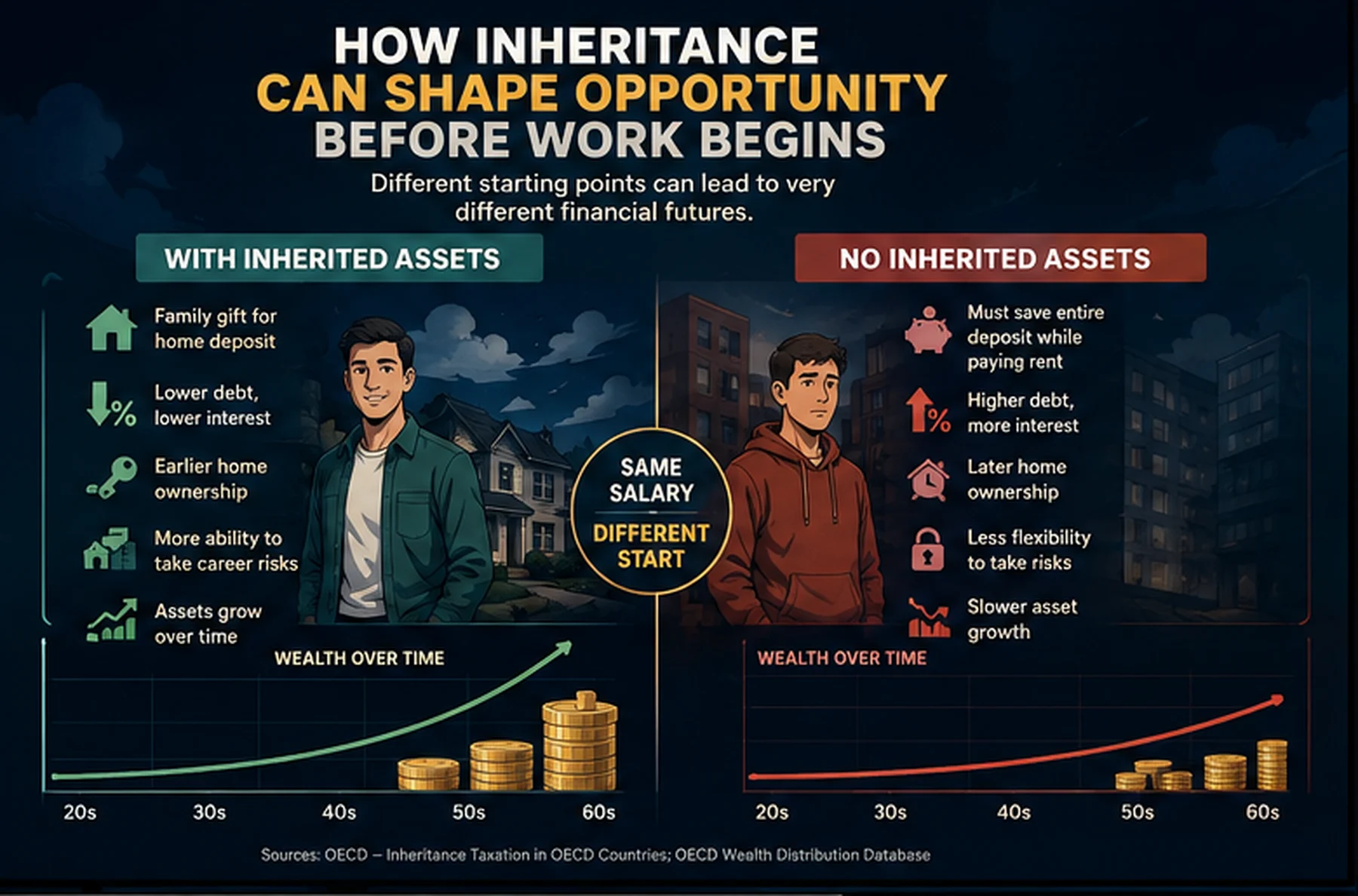
Economic success is often explained as the result of education, work, saving, and personal decisions. Those factors matter, but people do not all begin from the same financial position. An inheritance, family gift, debt-free home, or contribution toward a deposit can change when a person enters the housing market, how much interest they pay, whether they can take career risks, and how long their assets have to grow. Inheritance does not guarantee success, and receiving none does not make success impossible. It changes the starting conditions under which effort takes place. Consider two workers with similar salaries. One receives enough family support to cover a home deposit. The other must save the entire amount while paying market rent. The first worker can begin building home equity earlier and may avoid years of rent increases. The second may work just as hard but enter the market later, borrow more, or remain exposed to rent for longer. If property prices rise during that period, the gap between them can widen even though their incomes remain similar. The same process applies to education and business formation. A person with family support may study without taking large loans, accept a lower-paid internship that improves future opportunities, move to a city with better jobs, or start a business without risking immediate homelessness. A person without financial support may need to prioritize stable income, avoid unpaid training, support relatives, or delay investment. These decisions can appear conservative when viewed without context, but they may be rational responses to having no financial safety net. Wealth transfers also affect borrowing. Lenders generally offer better terms to people who already have assets, stable deposits, or family guarantees. This means wealth can reduce the cost of obtaining more wealth. Someone who receives property or cash may borrow less, pay less interest, and qualify for opportunities that are unavailable to a person with the same income but no collateral. Existing assets can also produce rent, dividends, interest, or capital gains. The result is a compounding process in which differences in the starting point become larger over time. This does not mean every inheritance creates a lasting advantage. Assets can be divided among relatives, poorly managed, consumed, taxed, or lost through business failure and market declines. Some inheritances arrive late in life, after major education and housing decisions have already been made. Others consist of property that is difficult to sell or maintain. Families may also transfer responsibilities and debts rather than usable wealth. The size, timing, and form of the transfer all matter. However, large transfers are more likely to go to people who are already relatively wealthy because wealthy families have more assets available to transfer. This is one reason wealth inequality can continue across generations even when income mobility improves. The debate over inheritance taxation reflects competing values. Supporters argue that taxing large transfers can reduce inherited inequality, raise public revenue, and ensure that economic position is not determined too heavily by family background. They may also argue that receiving an inheritance is different from earning income through work. Opponents argue that families should be able to pass on assets they accumulated and may already have paid taxes on. They also raise concerns about family businesses, farms, administrative complexity, avoidance, and the possibility that people will change saving or investment decisions. Tax design therefore matters as much as the existence of the tax. Thresholds can exempt ordinary household transfers while applying higher rates to very large inheritances. Payment periods or special rules can prevent heirs from being forced to sell a viable business immediately. Gift and inheritance rules must be coordinated so that wealthy households cannot avoid tax simply by transferring assets shortly before death. Enforcement and valuation must also be credible, particularly for private businesses, trusts, property, and assets held across borders. Inheritance policy is not the only way to address unequal starting points. Affordable education, healthcare, childcare, housing, public transportation, retirement systems, and access to reasonably priced credit can reduce the extent to which a person’s opportunities depend on parental wealth. Policies that help households build emergency savings and retirement assets may also broaden ownership. The goal does not have to be making every household equally wealthy. It can be ensuring that basic opportunities are not restricted to people whose families already own assets. A fair discussion should avoid two extremes. It is inaccurate to claim that everyone who inherits wealth has done nothing to deserve their position. Many recipients work, save, care for relatives, and use assets responsibly. It is equally inaccurate to claim that inherited support has no effect because the recipient also worked hard. Effort and advantage can exist at the same time. The central question is how much economic opportunity should depend on the family into which someone is born. Inheritance shapes opportunity because it changes debt, timing, risk, and access to appreciating assets before individual choices have had time to produce results. Recognizing that fact does not erase personal responsibility. It provides a more accurate explanation of why two people with similar talent and income can reach very different financial positions.
Sources: OECD, “Inheritance Taxation in OECD Countries”; OECD Wealth Distribution Database; OECD research on household wealth inequality.
Image caption: Two simplified financial paths showing how inherited assets can reduce borrowing needs and allow earlier asset ownership, while a person without inherited support may need more years of saving and borrowing.
Image alt text: Infographic comparing a person who receives inherited assets with a person who starts without a financial transfer, showing differences in debt, asset ownership, timing, and compounding.