

Why Recognizing Foreign Qualifications Matters
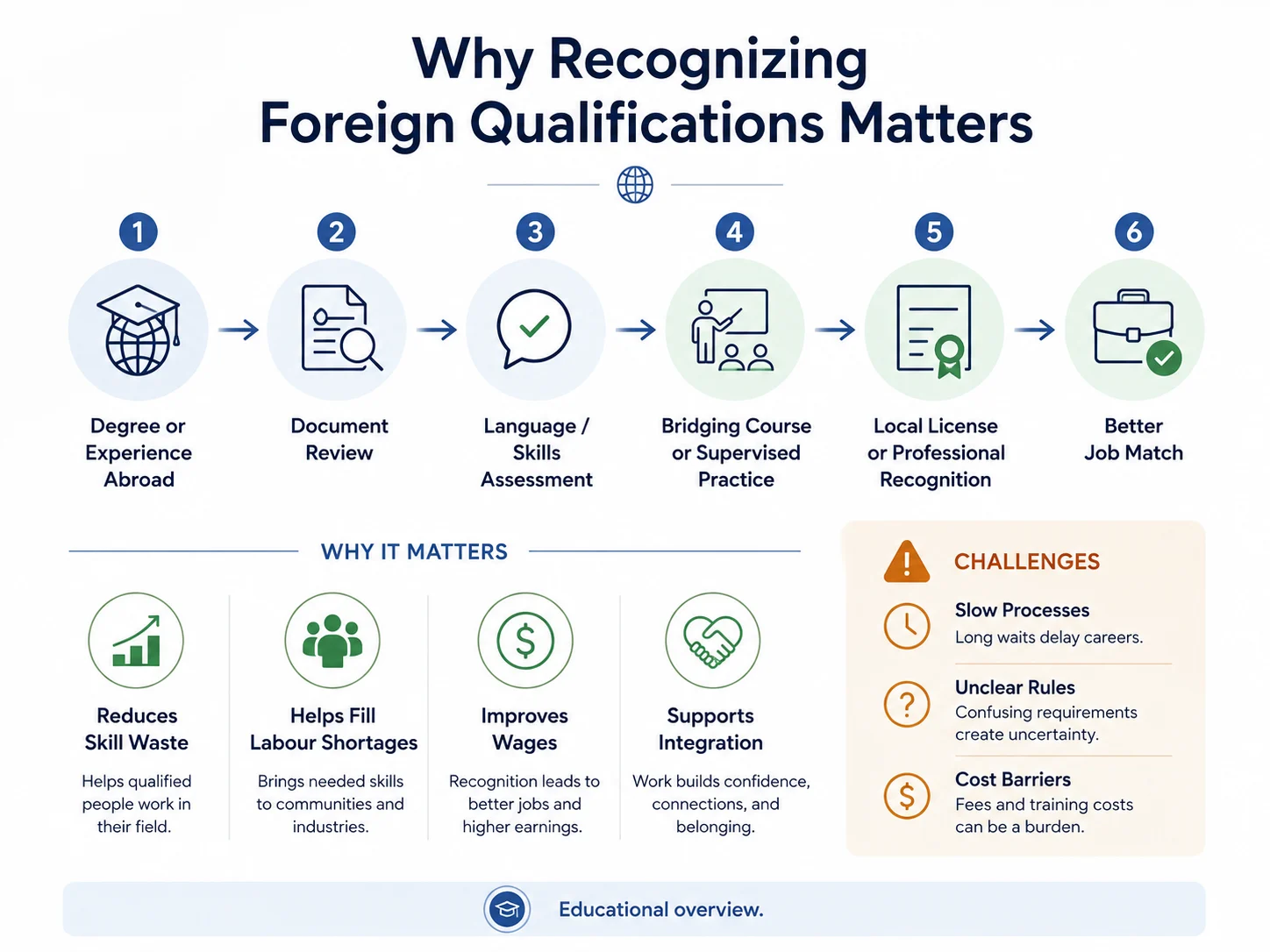
Recruiting skilled migrants does not automatically allow a country to use their skills. A nurse may arrive with years of clinical experience but be unable to practise. An engineer may work in a warehouse because employers do not understand the foreign degree. A teacher may wait years for documents to be assessed. This gap between qualifications and employment is not only a personal disappointment. It wastes human capital, reduces tax revenue, weakens integration, and leaves employers complaining about shortages while trained workers remain underused. Recognition is particularly important in regulated professions such as medicine, nursing, teaching, engineering, law, and certain skilled trades. These occupations require licences because mistakes can affect public safety. Governments cannot simply accept every foreign document without checking its authenticity and content. Education systems differ in course length, practical training, examination standards, and professional responsibilities. The challenge is to protect standards without creating a process that is unnecessarily slow, expensive, or impossible to understand. A fair system begins with clear information before migration. Applicants should be able to learn whether their profession is regulated, which authority makes the decision, what documents are required, what the fees are, and how long an assessment normally takes. Confusing responsibility across several ministries and professional bodies creates avoidable delay. Digital application systems can help, but only when they provide meaningful updates rather than a permanent “processing” status. Document review should compare the applicant’s education and experience with the essential competencies of the profession. A difference does not always require repeating an entire degree. A bridging course, supervised practice period, examination, language assessment, or targeted module may close a specific gap. Requiring a qualified professional to begin from the first year of education can be financially impossible and may drive the person permanently into a lower-skilled job. At the same time, automatic recognition without appropriate checks can endanger patients, clients, and professional trust. Proportional assessment is therefore the key principle: require what is necessary to demonstrate competence, not what is convenient for the bureaucracy. Language ability deserves separate attention. Professional communication is not identical to conversational language. A healthcare worker must understand symptoms, consent, medication instructions, and emergencies. A teacher must communicate with students and families. Language requirements can protect safety, but they should be connected to actual work tasks and accompanied by accessible training. Using an unrealistically broad language examination as an indirect barrier wastes qualified workers without necessarily improving professional communication. Employers also influence recognition. Even when a government accepts a credential, managers may not understand its value or may prefer familiar local experience. Standardized qualification statements, supervised placements, mentoring, and references from recognized institutions can help employers judge candidates more accurately. Public agencies should publish data on processing times, approval rates, common reasons for rejection, and outcomes after recognition. Without transparency, applicants cannot plan and policymakers cannot identify where skilled migrants are being lost. The consequences of non-recognition extend beyond wages. A person working far below their ability may experience frustration, reduced confidence, and limited contact with colleagues in their profession. Families may struggle financially even though a household member has valuable training. The host country loses productivity and may continue recruiting additional workers for the same shortage. Origin countries may also lose because they funded education that is never fully used. Recognition should not guarantee employment. Local experience, competition, and employer choice still matter. It should guarantee a reasonable opportunity to prove competence. Governments can improve systems by creating one clear entry point, accepting secure digital documents, coordinating professional bodies, offering partial recognition, expanding bridging programmes, providing occupation-specific language education, and allowing appeals against inconsistent decisions. Emergency programmes introduced for displaced people have also shown that temporary supervised work can help qualified professionals contribute while full assessment continues. A successful recognition system protects the public and values evidence. It does not assume that every foreign qualification is equal, but it also does not assume that foreign education is inferior. The correct question is not where a person studied. It is whether the person can demonstrate the knowledge, practical ability, language competence, and ethical standards required for the job. Countries that recruit skilled migrants while refusing to assess their skills efficiently create their own shortage twice: first by failing to train enough workers, and then by preventing trained newcomers from working.
Sources: OECD, “Making Integration Work: Assessment and Recognition of Foreign Qualifications”; OECD, “Indicators of Immigrant Integration 2023”; OECD, work on assessment and recognition of qualifications and skills.
Image caption: A simplified path from foreign education and experience through document review, skills assessment, bridging support, professional recognition, and suitable employment.
Image alt text: Infographic showing six stages for recognizing a migrant’s foreign degree or professional experience and the employment benefits and administrative challenges involved.