

How to Tell Whether Your Portfolio Is Really Diversified
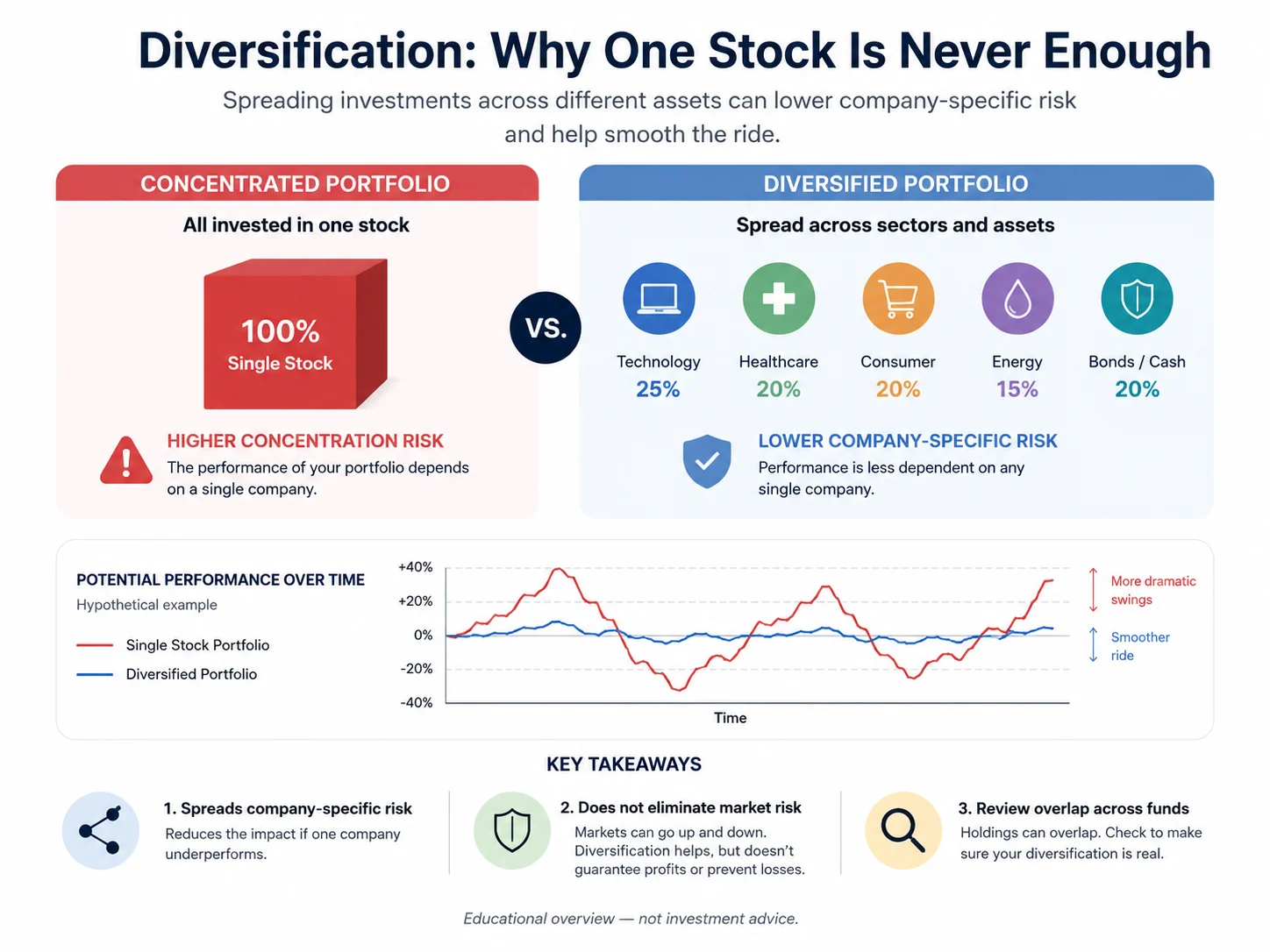
Owning several investments does not automatically make a portfolio diversified. An investor may hold five technology stocks, three technology-focused funds, and a broad market fund whose largest positions are the same technology companies. The account contains many products, but its performance may still depend heavily on one industry and a small group of businesses. Real diversification requires looking beneath the number of holdings and examining the risks they share. The first step is to measure concentration. List every stock, fund, bond, and cash position as a percentage of the total portfolio. A single company representing a large share can have an outsized effect on the result. Concentration can also be hidden inside funds. An investor who owns an individual company and two funds that both hold the same company may have far more exposure to it than the account summary suggests. Fund fact sheets and shareholder reports normally show major holdings, sector exposure, geographic allocation, fees, and investment strategy. Comparing those documents can reveal whether different funds actually provide different exposure. The second step is to examine sector concentration. Companies in the same industry often respond to similar forces, including regulation, interest rates, commodity prices, consumer demand, technological change, and supply disruptions. Ten companies from one industry may therefore fall together during an industry-specific crisis. Diversifying across sectors does not mean every sector must receive an identical allocation, but it does mean one economic theme should not control the entire portfolio by accident. The third step is to compare asset types. Stocks, bonds, and cash serve different purposes and carry different risks. Stocks may offer long-term growth but can experience large price declines. Bonds may provide income and lower volatility, although they can lose value when interest rates rise or an issuer’s financial condition weakens. Cash provides stability and liquidity but may lose purchasing power to inflation. The correct allocation depends on the investor’s goals, time horizon, financial situation, and tolerance for loss. A portfolio intended for a home purchase next year should not necessarily resemble one intended for retirement several decades away. Geographic exposure also matters. A portfolio invested only in one country is influenced by that country’s currency, economy, regulation, and political conditions. International exposure can spread some of that risk, although foreign investments introduce additional risks such as currency movements, different accounting practices, and geopolitical instability. Diversification is therefore not the elimination of risk. It is the deliberate distribution of risk. Another overlooked issue is correlation, meaning the degree to which investments tend to move together. Two companies may operate in different sectors yet remain exposed to the same economic factor. A bank and a property developer, for example, may both be vulnerable to a severe real-estate downturn. A semiconductor manufacturer and a consumer-electronics company may both depend on the same supply chain. Investors should ask what event could damage several holdings simultaneously rather than relying only on category labels. Portfolios also change over time. A position that begins at 8 percent may grow to 20 percent after a strong rally. This can produce concentration without any new purchase. Rebalancing means reviewing the portfolio and restoring its intended allocation by adding to underrepresented areas, reducing oversized positions, or directing new contributions differently. Rebalancing cannot predict the best time to trade, but it can prevent recent winners from quietly determining most of the portfolio’s future. Finally, diversification should remain understandable. Adding more products can create duplicated holdings, higher fees, tax complications, and a portfolio that the owner can no longer explain. A useful review asks five questions: What are my five largest underlying company exposures? Which sectors dominate the portfolio? Do my funds own many of the same companies? How would the portfolio respond to one major economic shock? Has recent performance moved the allocation away from my original plan? A portfolio is genuinely diversified when its holdings play different roles and do not depend on the same narrow outcome. Diversification cannot guarantee profits or prevent losses during a broad market decline. Its purpose is to make sure that one failed company, one struggling industry, or one incorrect prediction does not determine an investor’s entire financial future.
Sources: U.S. Securities and Exchange Commission, Investor.gov, “Asset Allocation and Diversification”; FINRA, “Asset Allocation and Diversification”; FINRA, “Concentrate on Concentration Risk.”
Image caption: An educational comparison between a concentrated portfolio and a portfolio spread across multiple sectors and asset types. Percentages and performance lines are hypothetical examples, not recommended allocations or historical returns.
Image alt text: Infographic comparing a portfolio invested entirely in one stock with a diversified portfolio spread across technology, healthcare, consumer businesses, energy, and bonds or cash.