

Pension Debates Are Really About Risk Sharing
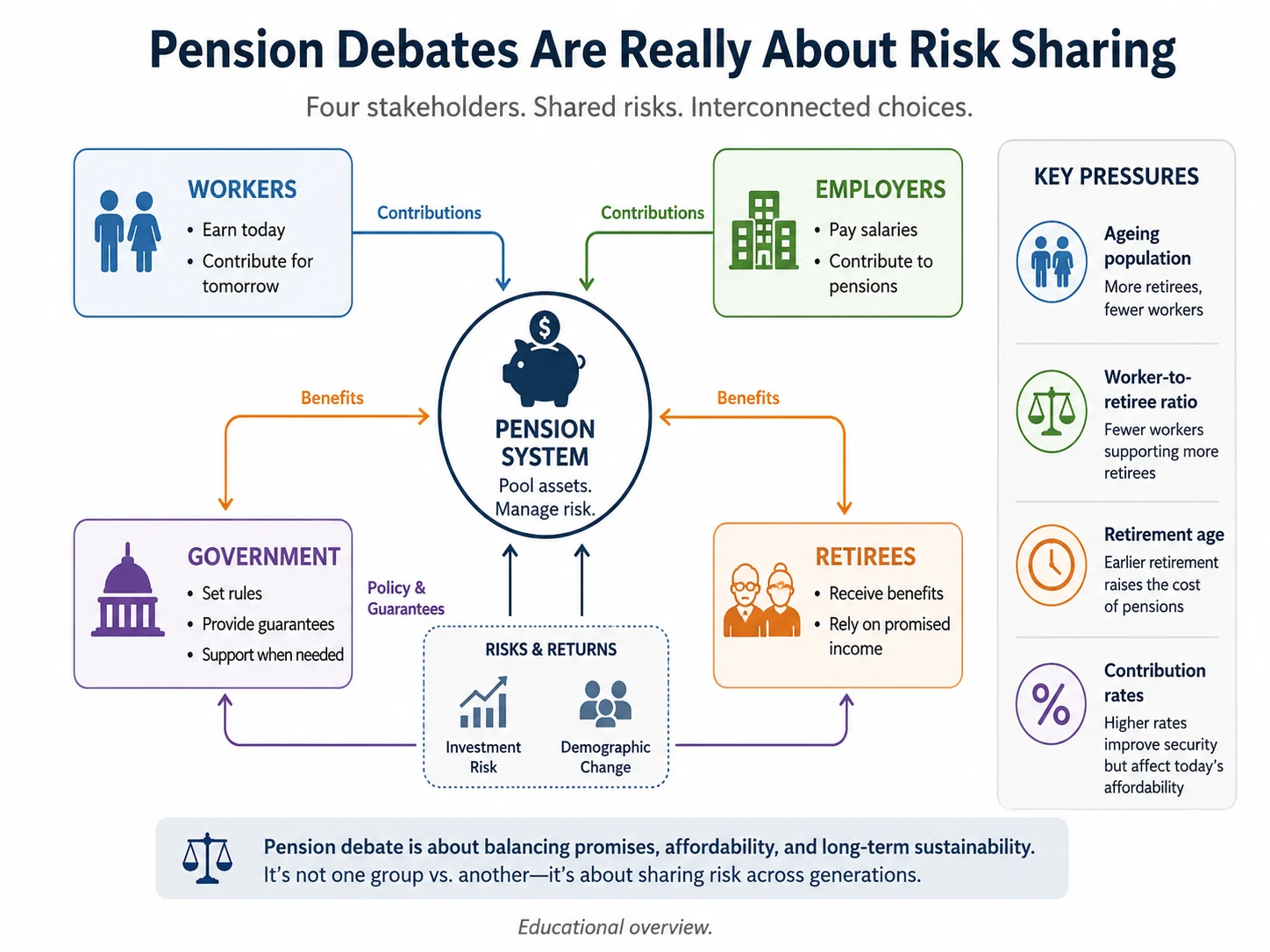
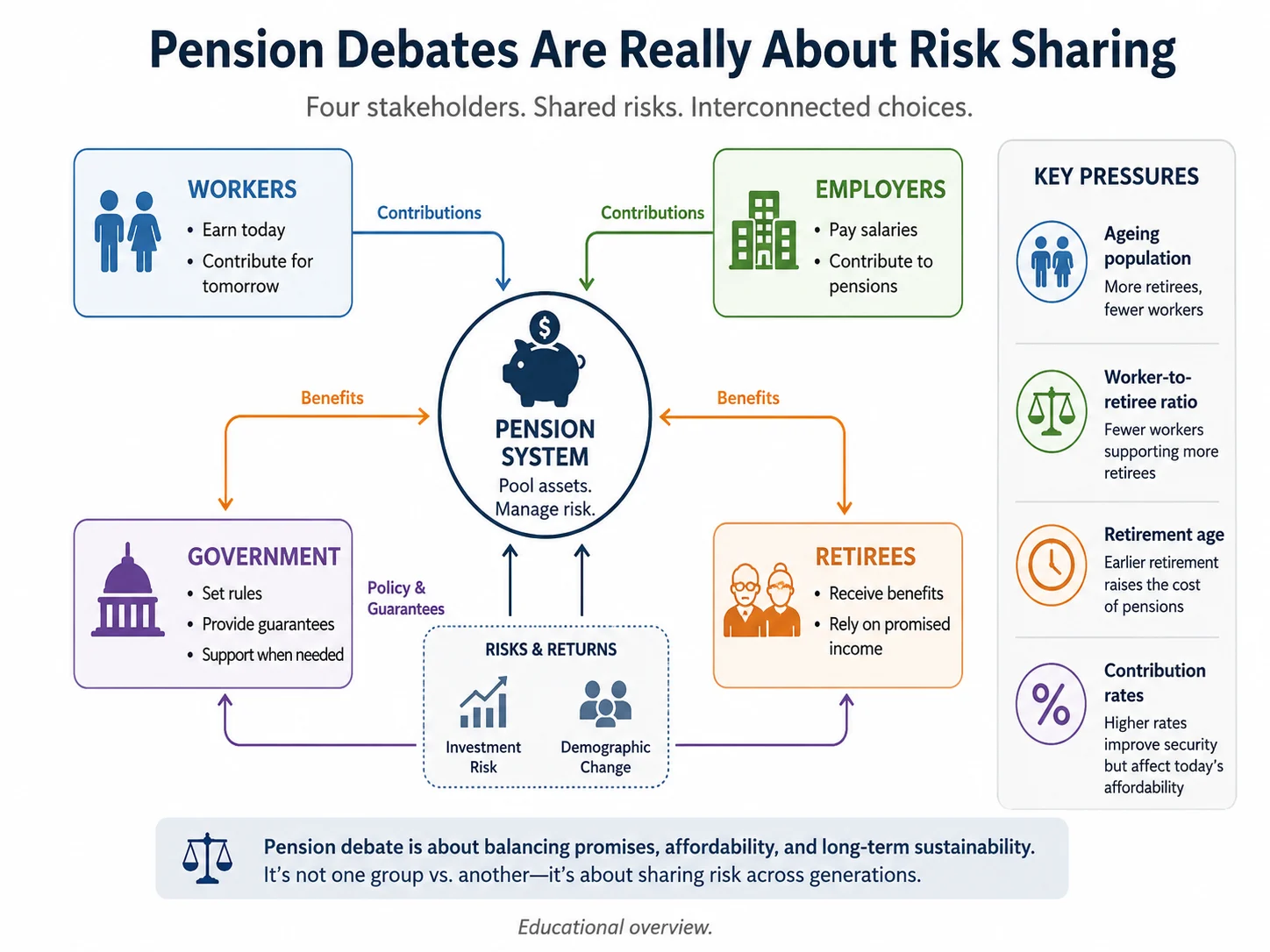
Pension arguments are often presented as a conflict between young workers and older retirees. Younger people worry that they will pay higher contributions for benefits they may never receive. Retirees fear that reforms will reduce income they planned around for decades. Governments worry about budgets, while employers worry about labour costs. Beneath these disputes is a larger question: who should carry the risks of longer lives, ageing populations, changing employment, inflation, and investment performance? Pension systems use different methods to share those risks. In a pay-as-you-go public system, contributions or taxes collected from current workers and employers finance benefits for current retirees. The system depends on the size and earnings of the workforce, contribution rates, retirement age, benefit rules, and government finances. When there are fewer workers relative to retirees, maintaining the same benefits may require higher contributions, later retirement, additional taxes, greater government borrowing, or reductions in future benefits. Each option shifts the burden to a different group. Funded pension arrangements invest contributions to finance future retirement income. They can reduce direct dependence on the future worker-to-retiree ratio, but they introduce investment and market risk. Poor returns, high fees, inflation, or retiring during a market downturn can reduce the value of savings. Defined-benefit plans promise income according to a formula, placing more funding and longevity risk on the employer, pension fund, or government. Defined-contribution plans place more risk on the individual because retirement income depends on contributions and investment performance. Neither structure eliminates risk. It decides where the risk appears. Retirement age is especially controversial. Longer life expectancy can mean that benefits must be paid for more years. Raising the retirement age improves financing and can increase an individual’s contribution period, but the burden is not equal. A healthy professional may be able to work longer, while a construction worker, caregiver, or person with chronic illness may not. A uniform retirement age can therefore be financially simple but socially unequal. Flexible retirement, partial pensions, disability protection, and rules that recognize demanding work can reduce the unfairness, although they make systems more complex. Contribution increases also create trade-offs. Higher rates can strengthen pension financing but reduce current take-home pay or increase employment costs. The effect is particularly difficult for younger and lower-income workers already facing expensive housing, childcare, and insecure employment. Benefit cuts protect current budgets but may increase poverty among older people who have limited ability to return to work. Tax financing spreads the cost beyond payroll contributions, but it competes with healthcare, education, housing, and other public spending. Migration can temporarily expand the contributor base, but migrants also earn pension rights and eventually retire. It can ease pressure while workers are active but cannot permanently replace pension design and productivity growth. Informal employment creates another challenge because workers and employers may not contribute regularly. People may reach old age without adequate benefits, forcing families or governments to provide support later. Extending coverage matters as much as adjusting headline contribution rates. Intergenerational fairness does not mean that every generation receives identical rules. Demographic and economic conditions change. Fairness requires transparent rules, sufficient notice, protection against old-age poverty, and a reasonable relationship between contributions and expected benefits. Sudden reforms imposed on people near retirement can break commitments they had little time to replace. Refusing any reform can transfer an unsustainable cost to workers who had no role in creating the original promises. Automatic adjustment mechanisms can connect benefits, contributions, or retirement ages to measurable changes in longevity and finances. They can reduce repeated political crises, but formulas still reflect political choices and should not operate without minimum protections. Pension debates improve when governments publish clear projections under several scenarios and explain who bears the cost of each proposal. Citizens should be able to see how changes affect low earners, caregivers, informal workers, people with disabilities, current retirees, and future workers. The objective is not simply to minimize pension spending. It is to provide reliable income in old age without creating obligations that future workers and taxpayers cannot sustain. A pension system is a long-term agreement across generations. Every reform changes how longevity, market, employment, and fiscal risks are shared. The honest debate is therefore not whether one generation deserves more. It is which combination of contributions, benefits, retirement ages, taxes, savings, and guarantees distributes those risks most fairly.
Sources: OECD, “Pensions at a Glance 2025”; OECD analysis of ageing and pension financing; World Bank work on pension reform, demographic change, and social risk sharing.
Image caption: Pension systems connect workers, employers, governments, retirees, and financial markets. Policy choices determine how demographic, investment, and fiscal risks are shared.
Image alt text: Diagram showing workers and employers contributing to a pension system, governments setting rules and guarantees, retirees receiving benefits, and demographic and investment risks affecting the system.