

Diversification: Why One Stock Is Never Enough
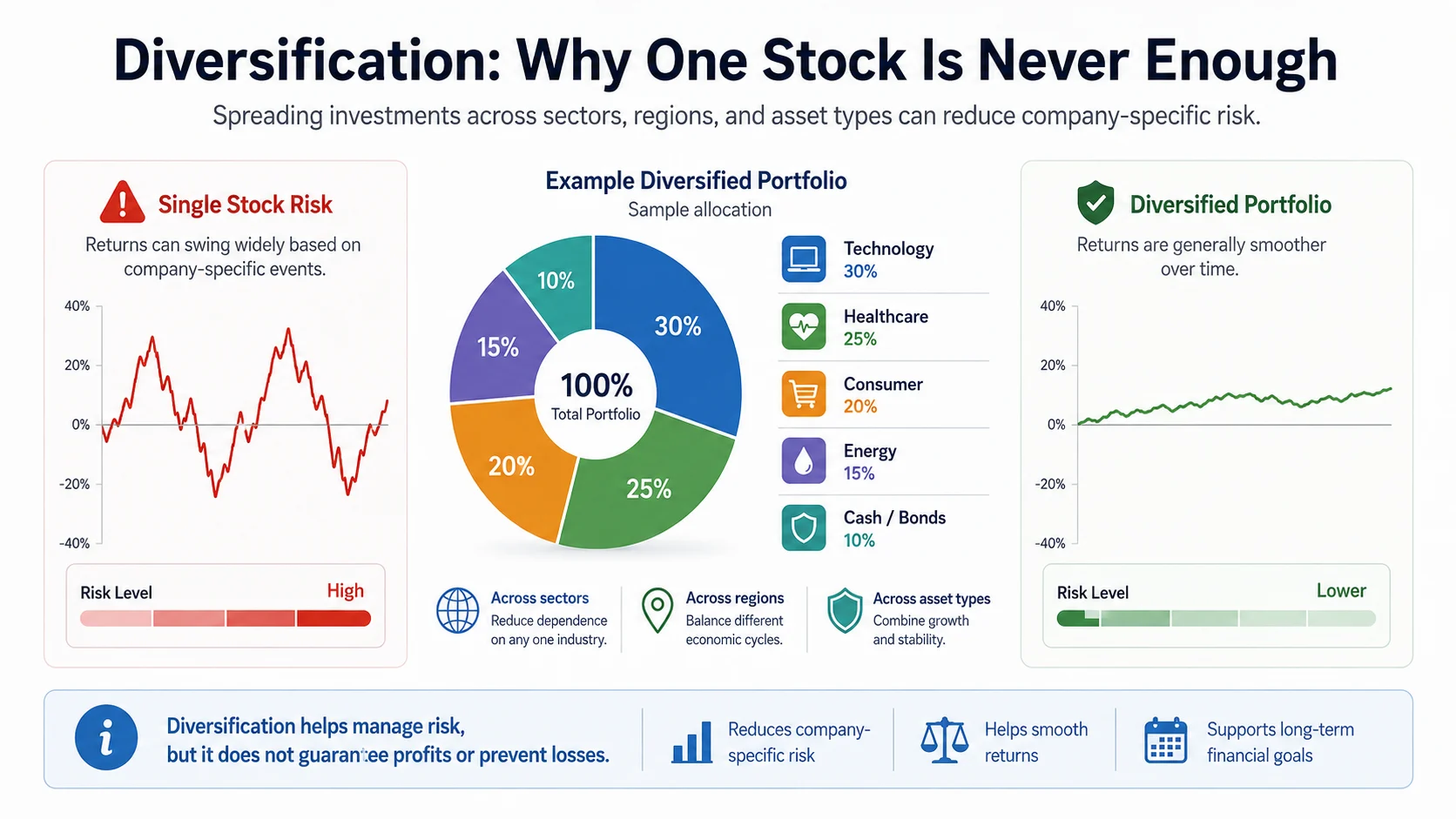
A great company can still be a dangerous investment when it becomes your entire portfolio. A single stock may rise because of strong earnings, a successful product, or optimistic expectations, but it can also fall suddenly after weak guidance, a regulatory decision, an accounting problem, a failed product launch, or the loss of an important customer. These events may damage one company even when the broader market remains relatively stable. Diversification is the practice of spreading money across multiple investments so that the failure of one company does not determine the result of the entire portfolio. It does not eliminate risk, and it cannot guarantee a profit, but it can reduce company-specific risk. Imagine two investors who each have $10,000. The first investor places the entire amount into one technology company. A 40 percent decline would reduce the portfolio to $6,000. The second investor divides the same amount across technology, healthcare, consumer businesses, energy, and bonds. If one holding representing 20 percent of the portfolio falls by 40 percent while the others remain unchanged, the total portfolio would fall by about 8 percent rather than 40 percent. This is only a simplified example, but it demonstrates why concentration can magnify both gains and losses. Proper diversification involves more than buying several company names. Ten stocks from the same industry may react similarly to the same interest-rate change, regulation, supply shortage, or economic slowdown. Investors can diversify across sectors, countries, company sizes, and asset types. A portfolio might combine companies from technology, healthcare, consumer goods, industrials, and energy while also holding bonds or cash for stability. The allocation shown in the accompanying image is an educational example, not a recommended portfolio. The correct balance depends on the investor’s financial goals, investment period, income, and ability to tolerate losses. Diversification can also be misleading when different funds own many of the same companies. An investor may hold three exchange-traded funds and believe the portfolio is broadly diversified, while all three funds place their largest weights in the same small group of large companies. Checking each fund’s top holdings, sector allocation, geographic exposure, and investment strategy is therefore important. Diversification should not be confused with collecting random investments. Every holding should have a clear purpose. Stocks may provide long-term growth potential, bonds may reduce volatility and generate income, and cash may cover short-term needs without forcing the investor to sell during a market decline. However, holding too much cash can create another risk because inflation may reduce its purchasing power over time. A diversified portfolio also requires maintenance. When one investment rises much faster than the others, it can become an unexpectedly large part of the portfolio. For example, a stock that originally represented 10 percent of a portfolio could grow to represent 25 percent after a major price increase. The investor would once again be heavily exposed to a single company. Rebalancing means reviewing the portfolio and restoring the intended allocation by buying or selling investments. This does not need to happen after every small market movement, but periodic reviews can prevent concentration from developing unnoticed. Diversification has limits. During a broad financial crisis or global recession, stocks from many industries and countries may decline together. Bonds can also lose value, particularly when interest rates rise or an issuer’s financial condition deteriorates. Diversification cannot protect an investor from every market-wide loss. Its main purpose is to prevent one company, industry, country, or asset type from controlling the entire outcome. Investors should also consider costs. Owning many funds may create overlapping holdings, transaction expenses, management fees, and unnecessary complexity. A portfolio containing hundreds of positions is not automatically better than a simpler portfolio. The goal is not to own the greatest possible number of investments, but to avoid excessive dependence on a small number of related risks. Before investing, ask four questions: How much of the portfolio depends on one company? Are several holdings exposed to the same industry or economic conditions? Do different funds hold the same major stocks? Would a large decline in one position threaten an important financial goal? These questions cannot predict the next market movement, but they can reveal risks hidden by recent strong performance. One stock may produce exceptional returns, but it can also turn a temporary business problem into a permanent financial setback. Diversification accepts that no investor can consistently know which company, sector, or country will perform best. Instead of relying on one prediction, it builds a portfolio capable of surviving when that prediction is wrong. That may feel less exciting than betting everything on a favorite company, but successful long-term investing is not only about maximizing possible gains. It is also about avoiding a loss large enough to prevent recovery.
Sources: Investor.gov, “Diversify Your Investments”; Investor.gov, “Asset Allocation and Diversification”; FINRA, “Asset Allocation and Diversification.”
Image caption: An illustrative comparison between single-stock concentration and a diversified portfolio. The allocation and performance lines are educational examples, not historical results or investment recommendations.
Image alt text: Infographic comparing the high volatility of a single stock with an example portfolio diversified across technology, healthcare, consumer companies, energy, and cash or bonds.